

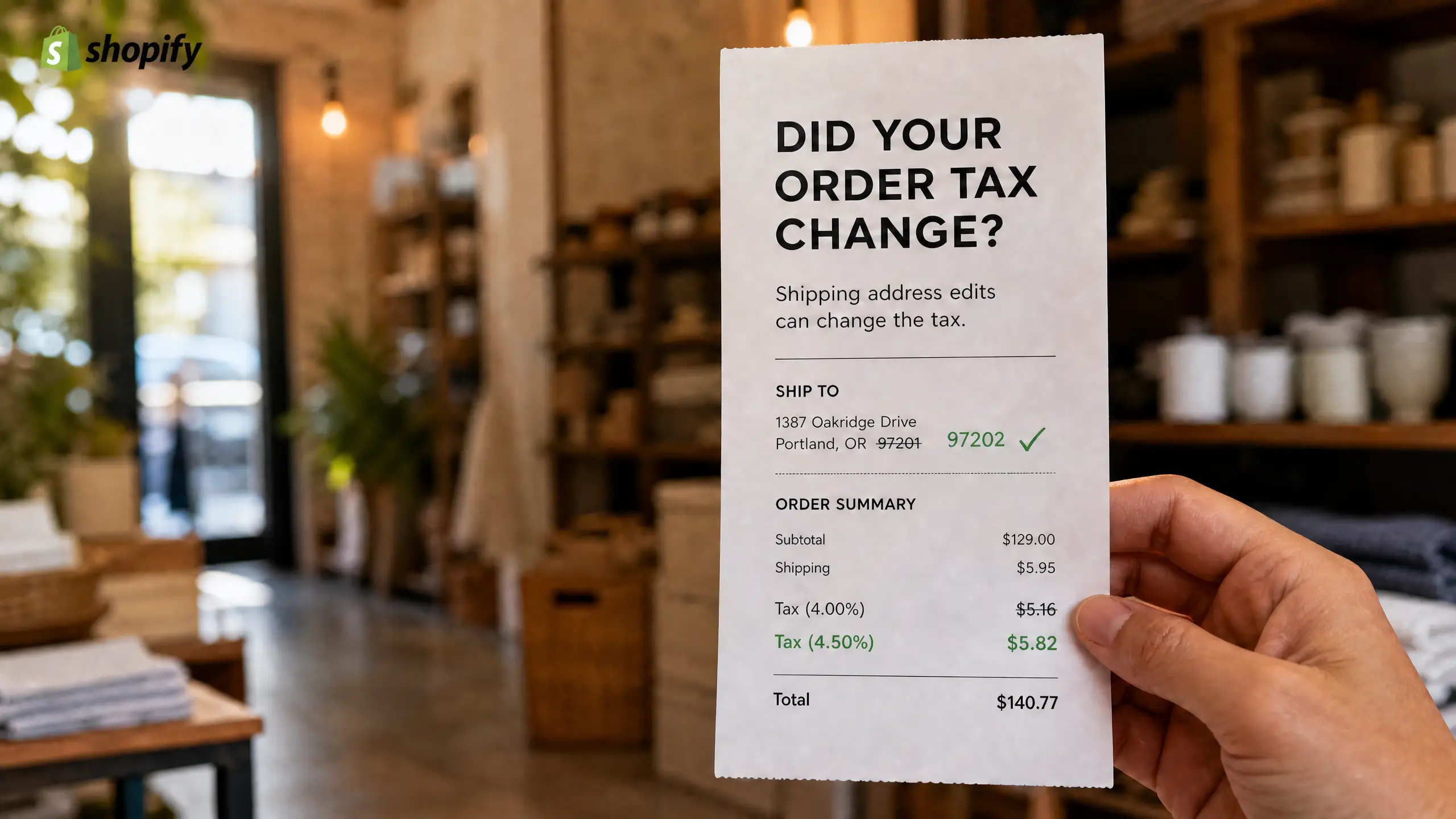
Your Shopify tax records may be off. Check now.
Shopify rolled out a quiet update that could still be affecting your books. If you have ever edited a shipping address after checkout, it matters to you.
What changed
Tax rates depend on where an order ships. That rule has not changed. What changed is how Shopify applies it after an order is edited.
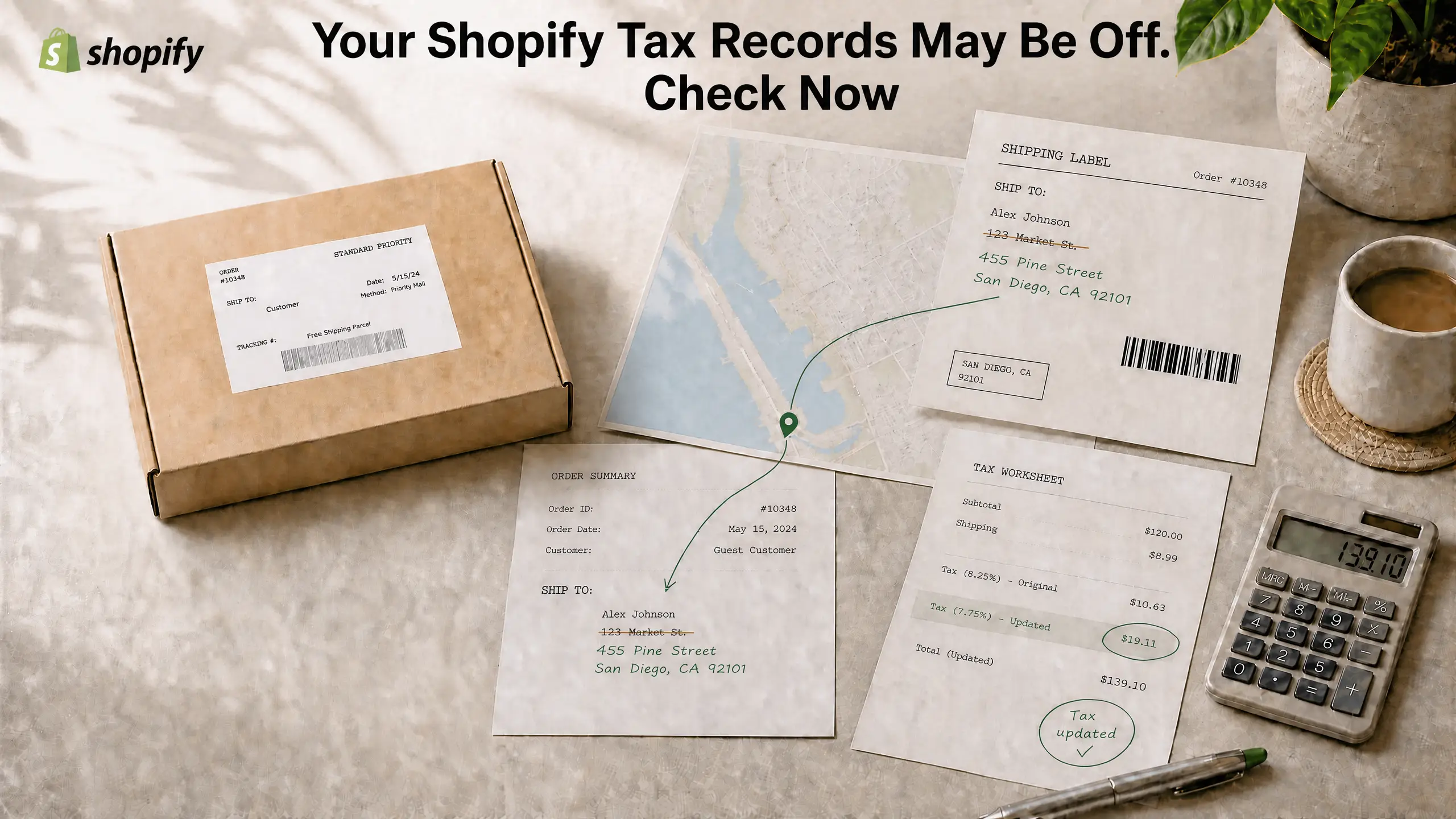
Before this update, changing the shipping address did not change the tax. The order kept the tax from the original destination. So an order that started in Oregon, where there is no sales tax, and got redirected to California, where it can run past 10 percent, still showed the Oregon tax on the record. The address moved. The tax did not. Across a busy month, those small gaps quietly pull your reporting away from reality.
As of August 13, 2026, that gap is closed. When you change a shipping address on an order, Shopify recalculates the tax for the new destination. You see a preview of the updated amounts before you save. If the change creates a payment difference, you see that too, and you can send the customer an invoice for the difference instead of absorbing it.
One thing worth knowing: the recalculation runs only when it is safe to apply, not on every single edit. The address change always goes through. The tax update is the conditional part. A routine correction that does not affect tax will not throw anything off.
One thing worth knowing:
Destination-based tax means the buyer’s location sets the rate, not your store’s home address. Most online sellers already operate this way. A customer in California pays California’s rate. Reroute that order to Texas and the rate should shift with it. Before this fix, Shopify did not make that shift on its own.
This is why the update matters for compliance and not just tidiness. Most US states tax by destination. The EU and UK apply VAT the same way. In every case the law follows where the order ships, not where it started. A single missed recalculation can repeat across dozens of edited orders, quarter after quarter, and nobody would notice at the time.
Tax authorities rarely flag small discrepancies right away. They surface during audits or filings, and by then the fix costs far more time and money than it would have up front.
Who should check their orders
This is worth a look if your store falls into any of these:
You correct shipping addresses after checkout. You reroute or reship orders. You run a wholesale or B2B operation where staff edit orders by hand. You sell across multiple US states, or into the EU and UK. You process high order volume, where even a small percentage of edits adds up.
The fix protects your future orders. It does not clean up the past for you.
How to check your records
Start with past orders that had an edited shipping address. Look for ones where the destination changed state, province, or country, since those are the edits that could have carried the wrong tax. Compare the tax charged against the final destination. If you find a mismatch, talk to your accountant before you adjust anything in your books.
Going forward there is nothing to enable. The recalculation happens inside the normal order editing flow. A simple monthly habit helps though: pull a report of edited orders and spot-check a handful for tax accuracy. That five-minute check can save you a much larger cleanup later.
Quick FAQ
Do I need to enable anything? No. It works inside the standard order editing flow, with no settings to change.
Does it recalculate on every address edit? Not always. Shopify applies the new tax only when it is safe to do so. The address edit itself always succeeds.
Will it fix past orders automatically? No. You still need to review historical orders for mismatches yourself.
What if I use a third-party tax app? Check with your provider. Some tools handle recalculation their own way, and you may find you no longer need that part of the app.
What if I use a third-party tax app?
A quiet tax bug is still a real risk to your books, your compliance, and your customer trust. Small updates like this one deserve real attention rather than a skim. The stores that check their records now will catch problems early. The ones that wait may meet those problems during an audit instead.
If you want help auditing your Shopify tax setup or reviewing past order edits, reach out to us at marketing@tychons.com. A short conversation now beats a compliance surprise later.