

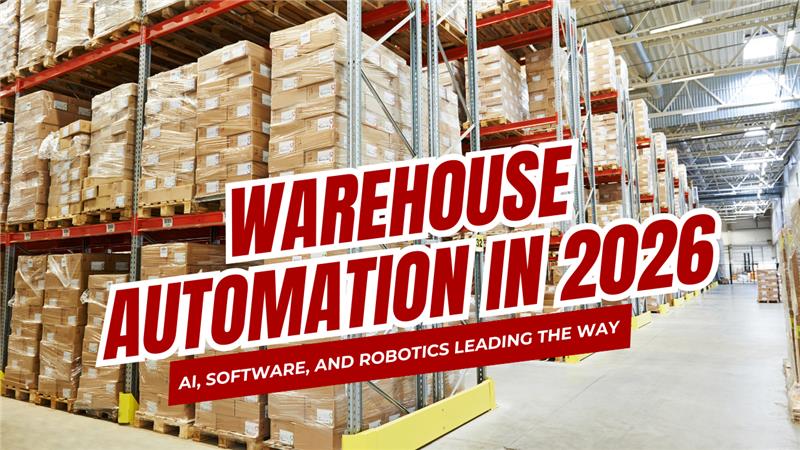
Warehouse Automation in 2026: AI, Software, and Robotics Leading the Way
Warehouse automation isn’t just evolving, it’s being redefined. As we enter 2026, AI, software, and robotics are converging to create smarter, faster, and more adaptable operations. Gone are the days of purely hardware-focused solutions. The future is blending software, artificial intelligence (AI), and robotics into seamless, adaptable operations. Let’s uncover the latest advancements redefining warehouse automation.
What’s Driving the Rise of Native Case Handling?
Traditional pallet-centric workflows are being replaced by auto-traying and case-to-shelf systems. These innovations eliminate excessive handling and repackaging, accelerating inbound flows and boosting accuracy. When combined with robotics capable of managing mixed-size cartons, warehouses can instantaneously move from receiving to shelving, streamlining operations end to end.
Why Is Inbound Automation Finally Stealing the Spotlight?
Historically, outbound fulfillment hogged the automation spotlight. In 2026, however, inbound operations like robotic depalletizing, pallet-building, AI-driven vision inspections, and AMRs for transport are becoming front and center. Organizations are investing heavily in these systems, as inbound automation now delivers significant return on investment and eliminates what used to be the biggest bottleneck in logistics.
Robotics-as-a-Service (RaaS) a Smart Choice for 2026:
Capital barriers are no longer a deal-breaker. With Robotics-as-a-Service (RaaS), businesses can subscribe to adaptable robotic solutions without the upfront cost of ownership. Providers handle maintenance and updates, enabling even small-to-mid-size warehouses to tap into enterprise-grade robotics on flexible terms.
Is Software Taking the Lead in Warehouse Automation?
Yes, it’s a game changer. Software is now the main driver of warehouse automation. Modern tools like Warehouse Execution Systems (WES) and easy-to-use platforms act as the “brain” of the warehouse. They connect systems like WMS, robots, IoT devices, and ERP in real time, making operations faster, more flexible, and data driven.
What Role Do AI, IoT & Data Analytics Play in Smart Warehouses?
- AI-powered robotics navigate and learn autonomously, boosting productivity and accuracy.
- Autonomous Mobile Robots (AMRs) navigate dynamic warehouse environments while flexibly supporting workflows.
- IoT-connected infrastructure like smart shelving and sensors collects real-time data to optimize inventory, forecast maintenance, and fine-tune labor deployment.
The Bottom Line
By 2026, warehouses are evolving from hardware-heavy setups to smart ecosystems powered by software and data. Robotic case handling, inbound automation, and Robotics-as-a-Service are making automation more accessible and efficient. Software-led orchestration, combined with AI, IoT, and advanced analytics, is driving real-time decision-making and agility. With strong change management, these innovations are enabling businesses to achieve greater efficiency, flexibility, and sustainable growth.
Ready to future-proof your warehouse? Contact marketing@tychons.com and unlock the power of AI, IoT, and Robotics-as-a-Service for smarter, faster operations.